

If you are not a subscriber of The Fanbase Builder, join 1.000+ artists, creators, and music industry executives who receive it for free.
Let’s dive into today’s topic:
How to build a community?
Nobody joins a community that hasn’t formed yet.
Why it matters
Artists are told to build their audience. Post consistently. Grow the numbers. However, audiences form around belonging, not output.
Earlier, I wrote about McMillan and Chavis (1986), who identified four conditions for a genuine sense of community:
Membership: A feeling of belonging.
Influence: Members matter to the group and vice versa.
Integration of needs: The community delivers something of value.
Shared emotional connection: History, common experiences, rituals.
Artists can’t manufacture all four conditions from scratch. But a working scene already has them.
Think of local music scenes, online communities, or creative collectives. These scenes have regulars, shared tastes, and trust built over time. Showing up in them means borrowing those conditions before you’ve built your own.
How it works
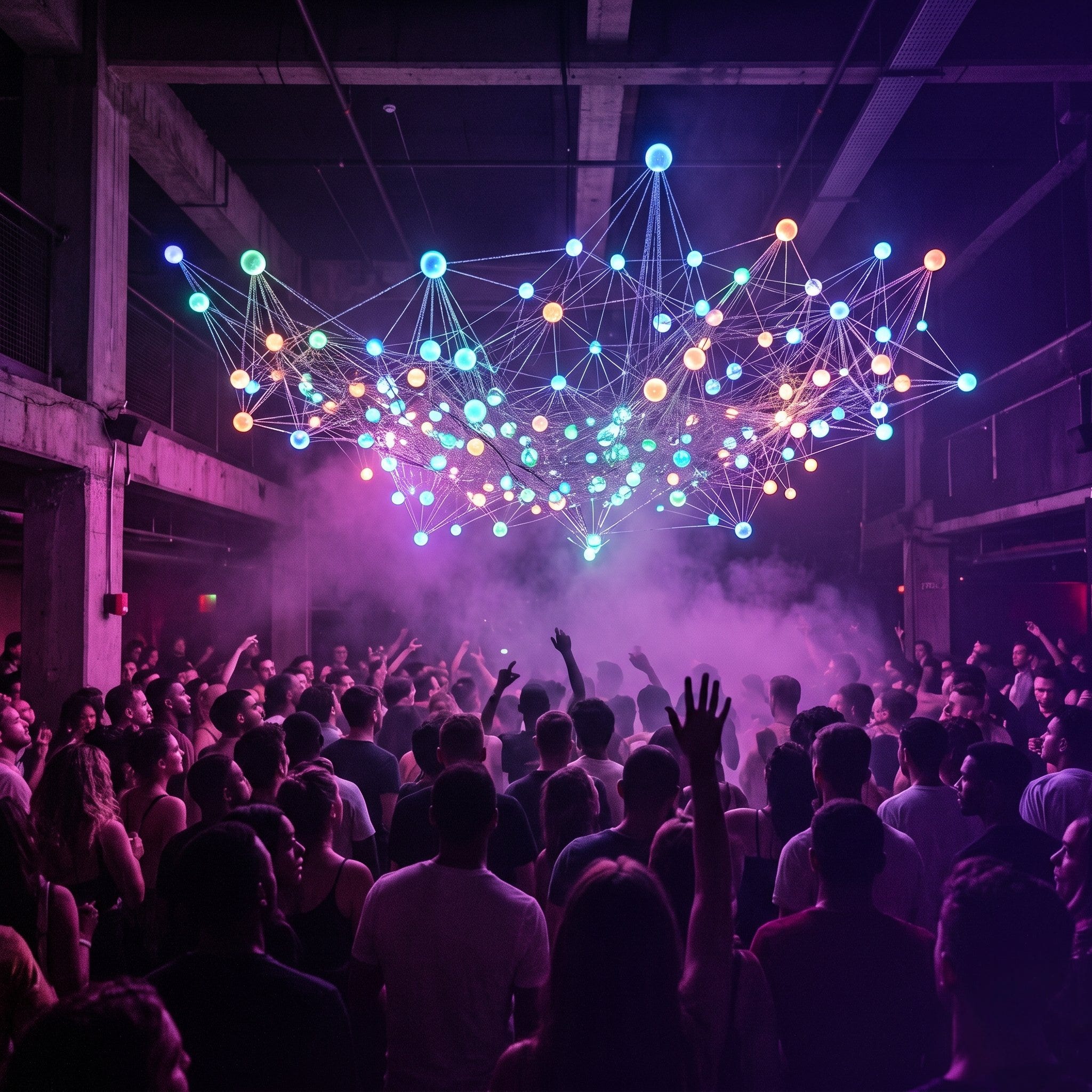
I think there are four recognisable phases in building a community:
Phase 1: Join an existing scene.
Find a community close to what you’re making. Not the most aspirational one, but the one you can actually show up for next week. Local venues, online forums, genre-specific communities, group chats with five other artists working in similar territory. Show up with genuine interest. Go to their shows. Collaborate without an agenda.
Phase 2: Subgroups form on their own.
Smaller clusters emerge inside any active scene. They self-organise around shared interests and repeated contact.
Phase 3: When the scene grows, you grow.
A scene that produces compelling work attracts attention, secures bookings, and draws audiences. Your growth becomes tied to the scene’s trajectory. Because you’ve built specific relationships within the scene, you’re a node rather than just a member.
Phase 4: You become a community.
At some point, the subgroup that formed around your work develops its own gravity. People are showing up specifically for you. The dynamic repeats: within your community, subgroups form. Fans who also make music. People who met through your work and now know each other. Artists you’ve started to support because you have the reach to do so.
Yes, but..
This takes longer than most artists expect, and sometimes growth doesn’t happen at all. You earn a place in a scene on the scene’s timeline, not your own.
Take action now
Artists can start by mapping the scene they’re actually closest to. Ask yourself: Where do I already belong, and how do I show up there more consistently?
Your thoughts
Further reading
Creating a strong sense of community (The Fanbase Builder)
McMillan, D. W., & Chavis, D. M. (1986). Sense of community: A definition and theory. Journal of Community Psychology, 14(1), 6–23. (full-text: pdf | online)
Artists can create momentum by making things happen (The Fanbase Builder)
Why fans wear band shirts like football jerseys (The Fanbase Builder)
How artists can find their niche (The Fanbase Builder)
The Guanxi approach to networking in music (The Fanbase Builder)
Lovely work you’ve written here! Ive been trying to wrap my head around the whole community thing ever since I went to RL 26 this year.
I want to join a community and just have fun sharing experiences but idk where to start looking or where I’d fit in! Have any tips for such a conundrum?